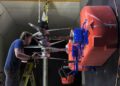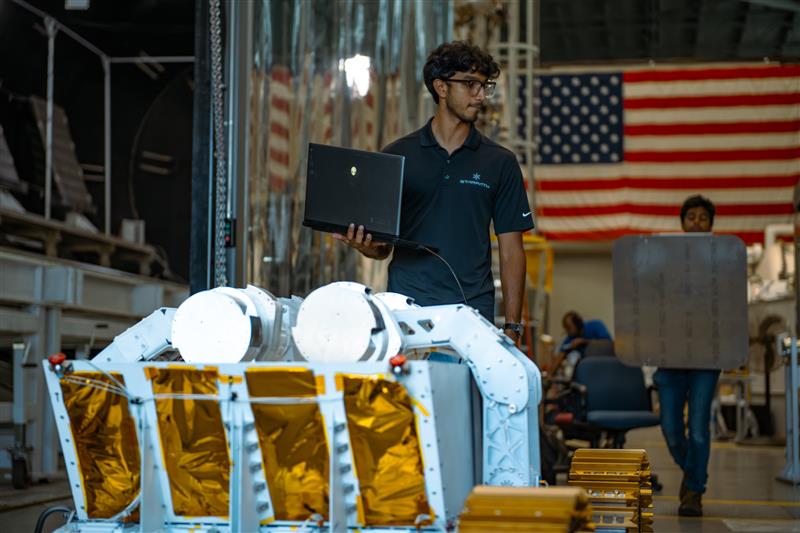
Starpath has completed thermal-vacuum trials of its upgraded lunar excavation and hauling rover inside the 20‑foot V‑20 chamber at NASA’s Marshall Space Flight Center in Huntsville, Alabama. The small business, which earned second place in NASA’s Break the Ice Lunar Challenge in June 2024, conducted a multi-day campaign in August to assess excavation performance and mobility under conditions designed to simulate the lunar South Pole.
What Starpath Tested
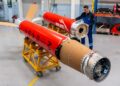
The Hawthorne, California–based startup brought a four‑wheeled rover engineered to excavate, collect, and transport lunar regolith in extreme environments. A notable feature is a dual‑drum barrel that can extend from the chassis—similar to a pair of claws—to rapidly scrape and gather compacted regolith while conserving finite battery power.
- Excavation system: Dual‑drum mechanism designed for rapid material collection.
- Mobility: Traversal over uneven, rocky terrain representative of lunar surfaces.
- Power management: Operations tuned to preserve energy in harsh thermal and vacuum conditions.
Inside Marshall’s V‑20 Thermal Vacuum Chamber
NASA Marshall’s Environmental Test Facility prepared a concrete slab with sandy, rocky features to serve as a regolith analog within the chamber. The V‑20 facility can manipulate vacuum, temperature, humidity, and pressure effects, and includes lighting to cycle illumination and simulate sunlight exposure.
- Testbed preparation: A heavy concrete platform with embedded terrain features was slid into the chamber on rails.
- Operational trials: Excavation and mobility runs over several days, with data collected on system performance.
- Environment simulation: Controlled vacuum and thermal profiles to approximate polar lunar conditions.
Why It Matters for Artemis and ISRU
Permanently shadowed regions at the Moon’s South Pole are believed to harbor water ice mixed with regolith. Future Artemis surface missions will depend on robust in‑situ resource utilization (ISRU) systems to excavate and transport this material for extraction, purification, and conversion into drinking water and cryogenic propellants. Demonstrations like Starpath’s provide risk‑reduction data for excavation hardware that must operate with limited power, abrasive soil, and extreme temperature swings.
From Challenge to Chamber
Starpath was one of three winning teams in the Break the Ice Lunar Challenge, a NASA Centennial Challenge that ran from 2020 to 2024. The team won second place overall at the live finale in June 2024 and earned a cumulative $838,461 across three levels of Phase 2. As part of the prize opportunity, the company was invited to exercise its rover in NASA Marshall’s thermal vacuum facility, extending technology maturation beyond the competition.
What’s Next
The team is refining the rover for operations in permanently shadowed regions, where low temperatures, loose‑over‑hard soil layers, and communication constraints challenge surface systems. Data gathered during the Marshall campaign will inform design iterations and operational concepts for future lunar resource prospecting and excavation missions.
Additional details and images are available via NASA: Lunar Challenge Winner Tests Technology in NASA Thermal Vacuum Chamber.