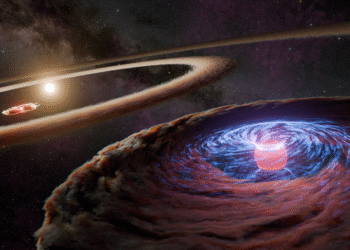
James Webb Space Telescope observations have revealed a carbon-rich circumplanetary disk encircling the massive exoplanet CT Cha b, providing the first direct measurements of the chemical and physical properties of a potential moon-forming environment. The system lies 625 light-years from Earth in Chamaeleon, and the findings were published in The Astrophysical Journal Letters.
Key Discovery
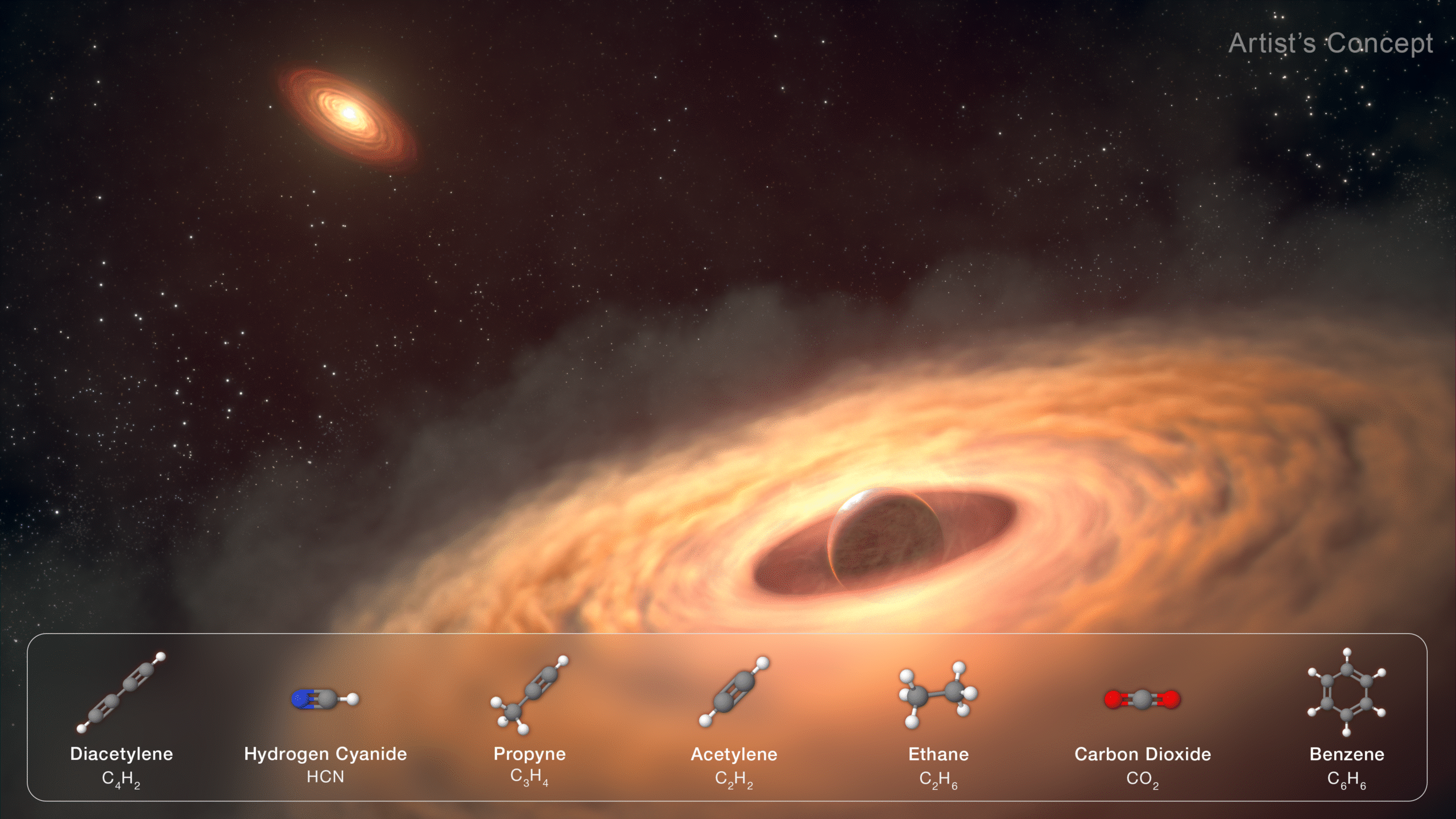
Using mid-infrared spectroscopy, Webb identified a suite of carbon-bearing molecules within the disk surrounding CT Cha b. The young host star is about 2 million years old and continues to accrete material, yet the planet–disk system is distinct from the star’s larger accretion disk. CT Cha b is separated from its star by roughly 46 billion miles, indicating the planet’s disk is an isolated structure where moons could assemble.
What Webb Saw
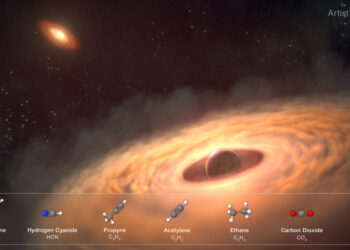
Webb’s MIRI (Mid-Infrared Instrument) medium-resolution spectrograph captured the faint planetary signal by applying high-contrast techniques to disentangle it from stellar glare. The circumplanetary disk shows clear signatures of multiple molecules associated with complex carbon chemistry, including:
- Diacetylene
- Hydrogen cyanide
- Propyne
- Acetylene
- Ethane
- Carbon dioxide
- Benzene
This carbon-rich profile contrasts with the chemistry of the nearby circumstellar disk, where water was identified but not the same carbon species. The difference points to rapid chemical evolution across the two environments on million-year timescales.
Why It Matters
Observing a circumplanetary disk in such detail advances understanding of how moons form around giant planets. In our solar system, Jupiter’s largest moons are thought to have condensed within a similar disk. Webb’s measurements offer a direct window into the raw materials and conditions that may shape exomoon systems, with implications for the prevalence and diversity of moons—some of which could host environments of astrobiological interest.
How the Team Did It
The research team mined archival Webb data and then conducted a deeper analysis targeting CT Cha b in the mid-infrared. By separating the planet’s spectrum from the bright background of the host star, the team quantified the disk’s molecular inventory and confirmed its carbon-rich nature. The approach showcases Webb’s sensitivity to planet-scale structures and chemistry at large orbital separations.
What’s Next
Follow-on Webb programs will survey additional young, wide-orbit giant planets to assess how common these carbon-rich disks are and to map the diversity of their physical and chemical properties. Comparative studies across systems will refine models of planet and moon formation and help place our solar system in context.
Source: NASA: Webb Spots Carbon-Rich Circumplanetary Disk Around CT Cha b