The Space Feed | Latest Space News
  • Home
  • News
    • Launches
    • Space Technology
    • Human Spaceflight
    • Space Exploration
    • Astronomy
  • Launch Schedule
    • Upcoming Launches
    • Completed Launches
  • Knowledge Base
    • All Missions
    • All Rockets
No Result
View All Result
  • Home
  • News
    • Launches
    • Space Technology
    • Human Spaceflight
    • Space Exploration
    • Astronomy
  • Launch Schedule
    • Upcoming Launches
    • Completed Launches
  • Knowledge Base
    • All Missions
    • All Rockets
No Result
View All Result
The Space Feed | Latest Space News

XRISM Resolve detects unusually dense, slow winds from neutron star GX13+1

September 17, 2025
in Astronomy

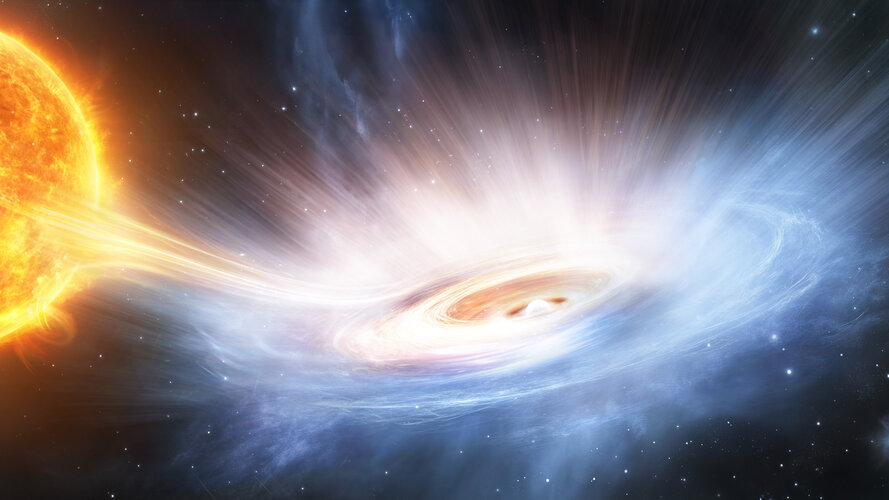
The X-Ray Imaging and Spectroscopy Mission (XRISM) has recorded unusually dense, slow winds from the neutron star system GX13+1, revealing a striking contrast with the ultrafast outflows commonly seen near supermassive black holes operating at similar radiative conditions. The result challenges prevailing models of radiation-driven winds from accretion discs and offers new insight into how compact objects inject energy and momentum into their surroundings.

What XRISM saw

On 25 February 2024, XRISM’s Resolve instrument observed GX13+1, a bright X-ray binary where material spirals onto a neutron star. Just before the observing window, the system brightened to near or above the Eddington limit, a regime where radiation pressure can push infalling matter outward. Resolve’s high spectral resolution captured a wind that was exceptionally thick yet moving at roughly 1 million km/h—fast by terrestrial standards but far slower than the 20–30% of light speed often measured near supermassive black holes under comparable conditions.

In addition to its lower velocity, the outflow from GX13+1 appeared smooth rather than highly clumpy, marking another clear difference from the ultrafast, structured winds previously identified near active galactic nuclei at the Eddington limit.

A temperature and coupling puzzle

The findings point to the role of accretion disc temperature and the type of radiation driving the flow. Accretion discs around supermassive black holes are larger and cooler, emitting primarily ultraviolet light, which couples efficiently to gas and can accelerate winds more effectively. By contrast, the hotter, X-ray–bright discs in stellar-mass systems like GX13+1 may couple less efficiently, producing slower, denser outflows even when radiation pressure is intense.

Why it matters

Radiation-driven winds regulate how black holes and neutron stars grow and how they influence their environments. In galaxies, this feedback can either trigger star formation by compressing gas or suppress it by heating and dispersing clouds. By contrasting wind properties across mass scales, the GX13+1 observation refines how models link disc emission, radiation coupling, and outflow dynamics—key ingredients for simulations of galaxy evolution.

Mission and instrumentation

XRISM, a mission led by JAXA in partnership with NASA and ESA, launched on 7 September 2023. It carries two instruments: Resolve, an X-ray calorimeter that measures the energy of individual photons with unprecedented resolution, and Xtend, a wide-field X-ray CCD imager. The GX13+1 dataset leverages Resolve’s spectral precision to distinguish ion species, measure gas velocities, and quantify column densities across multiple wind phases.

Key takeaways

  • GX13+1 produced an unusually dense, slow wind despite operating near the Eddington limit.
  • The outflow was smooth rather than clumpy, contrasting with ultrafast winds seen near supermassive black holes.
  • Differences likely stem from disc temperature and radiation type (ultraviolet vs X-rays) and their coupling to gas.
  • Results sharpen models of radiation-pressure feedback from compact objects and its role in cosmic evolution.

What’s next

The observation demonstrates XRISM’s capability to dissect multi-phase winds in compact systems and sets the stage for deeper surveys of neutron stars and black holes across accretion states. These measurements pave the way for next-generation, high-resolution X-ray observatories to map wind launching zones and quantify feedback with greater fidelity.

Study: “Multi-phase winds from a super-Eddington X-ray binary are slower than expected,” published by the XRISM collaboration in Nature. Source: ESA: XRISM uncovers a mystery in the cosmic winds of change.

Previous Post

Cygnus XL ISS Rendezvous Postponed After Early Engine Cutoff; New Burn Plan in Work

Next Post

IMAP, SWFO-L1, and Carruthers Integrated for Sept. 23 Falcon 9 Rideshare Launch

Related Posts

Astronomy

LOFAR and XMM-Newton confirm coronal mass ejection from a red dwarf, threatening exoplanet atmospheres

November 12, 2025
Astronomy

PLATO Assembly Complete; Final Tests Ahead of 2026 Ariane 6 Launch

October 10, 2025
Astronomy

Protoplanet WISPIT 2b Imaged Inside Disk Gap, Marking a Planet-Formation First

October 1, 2025
Astronomy

Gaia maps a massive stellar ripple sweeping the Milky Way’s outer disk

September 30, 2025
Astronomy

Webb Spots Carbon-Rich Circumplanetary Disk Around CT Cha b, Illuminating Moon Formation

September 29, 2025
Astronomy

JWST maps carbon chemistry in circumplanetary disk around CT Cha b, a likely moon nursery

September 29, 2025
Next Post

IMAP, SWFO-L1, and Carruthers Integrated for Sept. 23 Falcon 9 Rideshare Launch

Leave a Reply Cancel reply

Your email address will not be published. Required fields are marked *

  • Trending
  • Comments
  • Latest

NASA and SpaceX Conduct Crew-11 Dry Run Ahead of Launch

July 29, 2025

SpaceX Dragon Missions: Crew Prepares for Departure and Arrival at ISS

July 30, 2025

NASA Advances Supersonic Parachute Technology for Mars Missions

July 30, 2025

Upcoming Suborbital Rocket Launches from NASA Wallops: July 28-August 8, 2025

July 28, 2025

Dragonfly Mission Hits Major Test Milestones, Targets 2028 Falcon Heavy Launch

1

ESA Initiates Construction of LISA Mission to Detect Gravitational Waves

0

UK-France MicroCarb Satellite Launches to Enhance Global CO₂ Monitoring

0

NASA’s SpaceX Crew-11 Arrives at Kennedy Space Center for Upcoming Launch

0

ESCAPADE Reset to Nov. 13 After G4 Storm; Blue Origin VADR Launch Preserves Mars Trajectory

November 13, 2025

Brazil, INPE and ESA plan uptake of Biomass P-band radar data for Amazon carbon monitoring

November 13, 2025

LOFAR and XMM-Newton confirm coronal mass ejection from a red dwarf, threatening exoplanet atmospheres

November 12, 2025

DLR’s MAPHEUS-16 Sets Microgravity Payload Record with Twin Red Kite Motors

November 12, 2025

Popular Stories

  • NASA and SpaceX Conduct Crew-11 Dry Run Ahead of Launch

    0 shares
    Share 0 Tweet 0
  • SpaceX Dragon Missions: Crew Prepares for Departure and Arrival at ISS

    0 shares
    Share 0 Tweet 0
  • NASA Advances Supersonic Parachute Technology for Mars Missions

    0 shares
    Share 0 Tweet 0
  • Upcoming Suborbital Rocket Launches from NASA Wallops: July 28-August 8, 2025

    0 shares
    Share 0 Tweet 0
  • SpaceX Crew-11 Prepares for Launch: Final Steps Before Hatch Closure

    0 shares
    Share 0 Tweet 0
  • About
  • Advertise
  • Privacy & Policy
  • Contact
The Space Feed

© 2025 Stride Interactive Group

No Result
View All Result
  • Home
  • News
    • Launches
    • Space Technology
    • Human Spaceflight
    • Space Exploration
    • Astronomy
  • Launch Schedule
    • Upcoming Launches
    • Completed Launches

© 2025 Stride Interactive Group